I have never set foot in the state of Texas. And genuinely, conceptually, I think I would like it. Big sky country. Heat without the sticky suffocating humidity that makes you feel like you are walking through someone’s mouth. The whole western mythology of the place, the romanticized frontier of it. I find the idea of Texas genuinely appealing in the way you find appealing a place you have constructed entirely in your imagination from movies and music and other people’s nostalgia.
But Dallas. Dallas’ hockey team, specifically. What it brings out of me is actually ugly and I want to be honest about that upfront. I have made my peace with it. Not everyone has to be their best self about everything and this is the hill I have chosen.
On Rivalry, and What It Actually Is
I want to define how I’m using rivalry here because I think it gets flattened into something simpler than it really is. People talk about rivals like it just means a team you really do not want to lose to. A team you don’t like very much. And that is part of it, sure. But that is the surface version. That is the version that does not account what it actually feels like to have one.
A rival is not just a good team that beats you sometimes. A rival is a team with whom you have history. Specific, accumulated, unresolved history that does not go away between seasons. It sits somewhere in the back of your mind during the offseason and it comes forward in October when the schedule drops and you see the dates circled and you feel something that is not quite dread and not quite excitement but lives uncomfortably between the two.
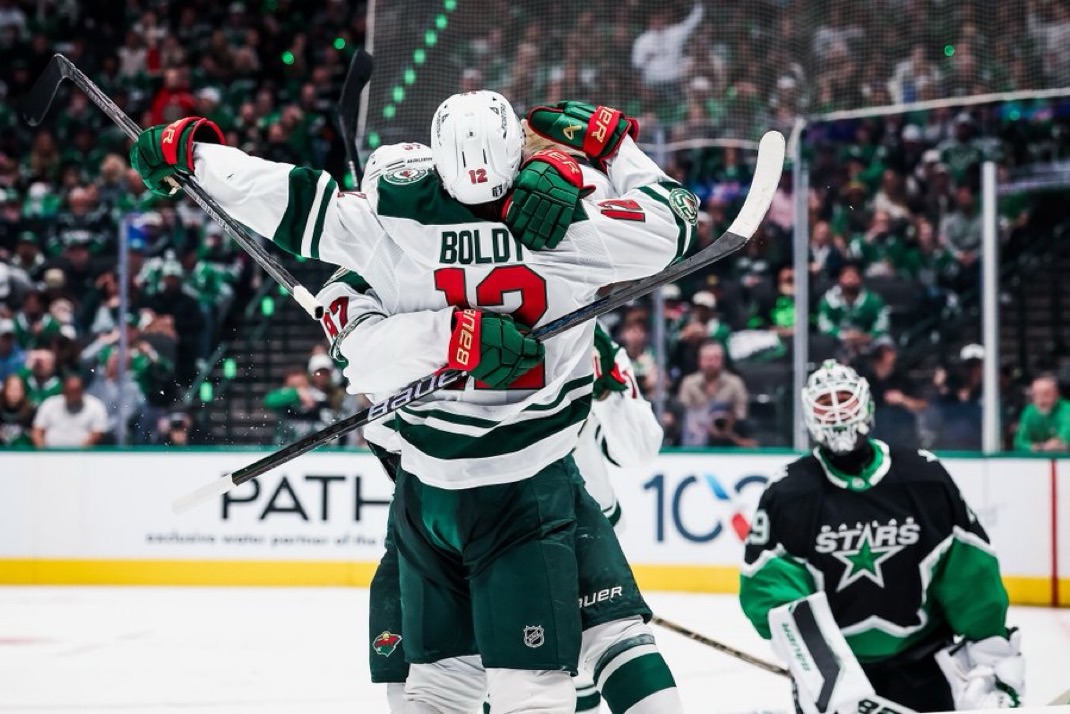
Dallas and Minnesota have met in the first round of the playoffs in 2016 and in 2023. Both times, six games, both times Dallas. And what that does, what that repeated outcome does, is build something between the two franchises that goes beyond the record. It builds a story. And stories are what turn opponents into rivals.
And then there is the layer underneath all of that, the one that predates the Wild entirely, the one that makes this rivalry something more complicated than two Central Division teams who keep meeting in April.
The Dallas Stars are the Minnesota North Stars. They have always been the Minnesota North Stars. The franchise was born in Bloomington, Minnesota in 1967, played there for 26 seasons, made two Stanley Cup Final appearances, and then in 1993 an owner named Norm Green, who the fanbase had taken to calling Norm Greed, decided he was done. When the Metropolitan Sports Facilities Commission denied Green the opportunity to improve the Met Center and connect it to the Mall of America, he announced in the middle of the season that the team would be moving to Dallas. There were other reasons too, documented and less flattering: a sexual harassment lawsuit against Green that resulted in his wife threatening to leave him unless he moved the team, mounting financial problems, a reported refusal to share an arena with the Timberwolves because of a conflict between Pepsi and Coca-Cola sponsorships, which is genuinely one of the more baffling footnotes in the history of professional sports franchise relocation.
On April 13, 1993, the North Stars played their last game at the Met Center. The building was demolished in December 1994. Minnesota was left without an NHL team. They would not have one again until the expansion Wild arrived in 2000, seven years later.
And Dallas, with that franchise, with those players, with that history, won the Stanley Cup in 1999.
The retired numbers, the legacy, the history, it all belongs to the Dallas Stars. Neal Broten’s number 7. Mike Modano’s number 9. The two Stanley Cup Final appearances Minnesota fans watched from Met Center. All of it traveled south on a moving truck driven by a man his own fanbase despised.
So when I say I hate Dallas, I want to be clear that there is something underneath that hatred that is older and heavier than a first round exit. The Wild were given to Minnesota, an expansion team promised by a league that had just allowed its franchise to be taken from the state of hockey and dropped in a city with, at the time, approximately two sheets of ice in the entire metropolitan area. You can still see North Stars jerseys at Wild games to this day. The Wild even wear reverse retro sweaters that echo the North Stars’ color scheme. The ghost of that franchise haunts this one and everyone in Minnesota knows it, even the fans like myself young enough that they never watched a North Stars game.
That is the story. That is what sits underneath the record and the series losses and the playoff exits. Dallas did not just beat us twice in the first round. Dallas is, in the most literal sense available, us. They took the franchise. They took the history. They took the Cup. And then they had the audacity to keep showing up in April to beat us with it.
So yes. I find what they bring out of me genuinely ugly.
I think that’s fair.
The other thing that makes a real rival is that they have to be able to actually hurt you. This is important. You cannot have just contempt for a rival. You can have contempt for a bad team, a team you expect to beat, a team that does not threaten you. A rival requires the discomfort of knowing that the other side is good enough to do real damage. That they have done it before. That they could absolutely do it again. The fear is part of the package, and if you are being honest with yourself, which most fans are not particularly interested in doing, the fear is part of what makes the whole thing feel like something.
Sports Rivalries are Older Than us
Here is where I get a little pretentious, and I am going to lean into it because I think the idea is actually worth taking seriously.
Human beings are tribal in a way that goes much deeper than preference or habit. The capacity to identify your group and distinguish it from another group is not a personality quirk. It is structural. It is, anthropologically speaking, one of the foundational features of how human communities have always organized themselves. In-group and out-group. Us and them. The village on this side of the river and the village on the other. The psychological research on this is extensive and consistent and the finding is not flattering to our self-image as rational creatures: we are extraordinarily good at constructing categories of belonging and extraordinarily resistant to revising them once we have.
For most of human history, that instinct expressed itself in ways that were considerably more destructive than what happens on a hockey rink. Territory. Resources. Power. The rival was not a metaphor. The rival was an actual threat, and the intensity of feeling surrounding them reflected that reality with reasonable accuracy.
What organized sport does, and I think this is genuinely one of the more elegant things human culture has stumbled into, is inherit the entire structure of that impulse and give it somewhere to go that does not end in anyone actually dying. The jersey stands in for the banner. The playoff series stands in for the siege. The rivalry, with all of its accumulated history and genuine animosity and completely disproportionate emotional intensity, plays itself out over seven games in an arena and then everybody goes home and the worst consequence is that you have to see someone celebrating on your timeline.
The feeling is real but stakes are constructed. The distance between those two facts is where sport lives, and it is, I think, one of the more genuinely beautiful things about it.
We gave the war somewhere to go. We put it on ice. We sold tickets.
So what does this actually look like?
It looks like caring too much about a game being played by people you have never met in a city you may never visit. It looks like knowing the name of the other team’s fourth line center in a way you definitely do not know the names of your local elected officials. It looks like your mood on a Monday being in direct and traceable relationship to what happened on Sunday night. It looks like a completely involuntary physical response to a jersey color.
It looks like Twitter at eleven o’clock on a Tuesday during playoff season. And this I think is where it gets genuinely interesting from a sociological standpoint, because what happens in rivalry spaces online is one of the more honest windows into what rivalry is actually doing to people. It is not really about hockey. The hockey is the language. The conversation underneath is about belonging and identity and the human pleasure of having a side, of being declared for something, of knowing with total clarity who you are rooting for and who you are rooting against.
Watch fans of two rival teams find each other in the replies. What you are watching is not a disagreement about analytics. It is two people performing tribal allegiance in real time, each one constructing a version of their opponent that confirms what they already believed, each one interpreting every piece of evidence through a framework that arrived fully formed before the argument started. Nobody is going to change their mind. Nobody is trying to. The point is not the destination. The point is the declaration. I am this. You are that. And right now in April that distinction means everything.
There is something I find deeply human about that. Embarrassingly, completely, recognizably human.
In Defense of Irrational Hatred
I want to make a case here which is that the irrationality is not the problem. The irrationality is the point.
There is a brand of sports commentary that tries to sand off the edges of rivalry into something more respectable. Appreciation for a worthy opponent. Respectful competition. The dignified acknowledgment that the other team is also comprised of skilled professionals doing their jobs. And sure, fine. Sportsmanship is real and good and I am not arguing against it as a concept.
But I am not interested in being measured about Dallas right now and I think that is okay. More than okay. I think the irrational edge of rivalry is precisely what makes it worth having. Because the thing that makes winning feel like something is the same thing that makes losing feel like the kind of loss it feels like. You cannot have one without the other. You cannot manufacture the high of a playoff series going seven in your favor if you have not also genuinely dreaded the possibility that it does not. The Dallas Stars are not just an obstacle between the Wild and the second round. They are, in the emotional economy of being a Wild fan, the reason any of this has the weight it has.
If losing to them did not bring out something a little ugly in me, then beating them would not mean what I need it to mean. The ugliness is load-bearing.
I want to be precise about what it is, exactly, that I feel when I think about the Dallas Stars, because I think vague sports hatred is boring.
The 2016 series. The 2023 series. Six games, both times. The way a series loss in six feels, which is worse than a sweep in some ways because you had enough games to really believe it was going to go differently and then it did not. The way Oettinger looks when he is locked in. The way this matchup seems to bring out a version of this team that is not quite the version that got them here. I have watched this movie. I know some of the dialogue already.
And yet I am sitting here in late April, genuinely, non-performatively convinced that this year is different. That this version of this team is not the version that lost those series. That the Wild are healthier and more dangerous and better constructed for a seven game series than they have ever been going into one of these.
Whether I am right about that is something only games 5 and 6 can answer.
But I want to be on record: I hate Dallas. I mean that in the most affectionate and ultimately self-aware way possible. I need them to be there. I need the history and the sting of it and the weight it gives to what happens next.
Because sports rivalries are one of the most human things we have, this constructed and agreed-upon theater of war that we fill with real feeling and real stakes and then care about deeply.
And even if this is over and done within six then damn at least we got to feel something like this.
Leave a Reply