Well. Where do I even begin?
Do I start with the heartbreaker of Game 5? Do I start with winning the first round for the first time since 2015, finally slaying the dragon that had been sitting on this franchise’s back for eleven years? Do I start with the Quinn Hughes trade, the moment this team stopped being a very good team and started being something that felt dangerous? Do I start with October, that first month of the season where it felt like it might be over before it ever really started?
Maybe the best place to start is actually the Summer of 2025. Because the beginning of this story for me is not April. It is not even October. It is June, in North Carolina, in the heat.
The Carolina summer feels so far removed from Minnesota and Wild hockey that it almost exists entirely apart. The offseason has a way of going on forever, rolling through the hundred-degree days with no particular urgency. I survive it the way fans of teams not playing in June always survive. I watch the cup run of the other teams, always the other teams. I watch someone else’s captain lift it. By the time they do, the sting of our own exit has usually subsided into something with less bite and more familiarity, the resignation of a Wild fan who has been here before.
I sustain myself on the draft. Another hit off the hockey bug, caring about where a teenager ends up. I make it through free agency with insider notifications sent directly to my phone like a person with a very incurable condition. I track the rumors. I read the takes. I form opinions about signings that will not affect my life in any material way.
And then we enter no man’s land. That stretch of the calendar where the thing that occupies so much of my mind for ten months of the year goes completely, disconcertingly silent. Even my coursework pauses in the summer, the one other outlet I have for thinking about this sport too seriously. There is nothing to track or analyze or argue about. The sport just stops and takes a large piece of my daily internal monologue with it.
It is a strange kind of withdrawal. This low-grade ambient absence. The group chats go quiet. The podcasts start grasping. The beat writers pivot to speculation and salary cap math and I read all of it anyway because it is the closest thing available. Maybe how much I think and care about this sport is embarrassing. I am not going to pretend it is not true.
By the time training camp and then October rolls around I am aching for it in a way that feels almost physical. Not just for the Wild specifically, though that too. For the sport. For what it does for me and for people and for the color it gives to a year. For the way it fills in the outline of the calendar and makes Tuesday nights in November mean something. I love this team, sure. But what I love more broadly is what hockey is, what it means to have something to care about this much for this long, what it means to belong to a thing that is bigger than any single season and carries you from one October to the next whether the Aprils are kind to you or not.
I have been a Wild fan long enough that the ache at the start of the season is inseparable from the grief at the end of it. They are the same feeling, just pointed in different directions. The wanting and the losing and the wanting again. That is the full loop of it. That is what I signed up for, more or less knowingly, a long time ago.
October did not exactly help with any of that.
The Wild finished third in the Central Division, which sounds stable and respectable until you remember what the first month of this season looked like. It felt, for a stretch in the fall, like the whole thing might collapse before it ever got going. Injuries, inconsistency, the anxiety of a team that you know is good enough but cannot currently prove it. Wild fans are not people who handle uncertainty with grace. We have too much history for that. We know how quickly good enough becomes not quite. We have watched it happen enough times that we do not need very many bad weeks in October before the old familiar dread starts warming up in the bullpen.
And then it didn’t collapse. And then it got better. And then Quinn Hughes arrived and the blue line transformed overnight into something that made you rub your eyes because surely that’s not my team I’m looking at. Three players on this roster won Olympic gold. Jesper Wallstedt became one of the best young goalies in the league. The team cracked a hundred points in the regular season. The power play clicked. And suddenly it was April and the Wild were in, healthy and dangerous and deep in a way they had not been heading into a postseason in years.
For the first time in a long time, the ache at the start of October paid off into something that felt like it was actually going somewhere.
The first round was Dallas. Of course it was Dallas.
I have written about what Dallas means to me and to this franchise and I will not relitigate it here. What I will say is that going down 2-1 in that series was full of the refined terror of a Wild fan who has seen this movie. The ceiling closes in. The old familiar feeling arrives. You start doing the math on Game 7s and historical patterns and none of it helps.
But somehow Minnesota dominated Dallas at even strength throughout the series and won the next three. The Wild advanced to the Second Round for the first time since 2015.
Eleven years. We had not done this in eleven years.
I did not know what to do with myself. I do not think any of us did, really. The group chats went from tense and quiet to completely unintelligible. People were crying. Not the polite, dignified kind of crying, but the ugly, surprised kind that comes from somewhere you forgot was still tender. The kind that happens when something you stopped letting yourself believe in finally arrives and your body has not quite caught up to the information yet.
There were Wild fans in that building who had been watching this team exit in the first round since they were children. Who had grown up, gone to college, gotten jobs and apartments and lives, and never once seen their team still playing in May. Who had spent eleven Aprils learning to manage the hope downward, to hold it loosely, to not let it get too far into them where it would cost too much to remove. Eleven years of building that callus.
And then a shot deflected off a Dallas defenseman and past Oettinger and the horn went and it was over and none of the callus mattered anymore.
One of the fans I spoke to for this article regarding this season was in the arena for it. This fan described standing there in the middle of all of it and feeling, underneath everything, the perseverance of hope. That is the phrase they used. Not the reward of hope. Not the vindication of hope. The perseverance of it. The thing that survives all the first round exits and the rebuilds and the almost and the not quite and keeps showing up anyway, year after year, because that is simply what it is.
It did not feel entirely real, which I think was on purpose. Some protective instinct trained into Wild fans by a decade of disappointment. Do not fully believe it until it is over. Do not let yourself have it completely until you are absolutely certain it is yours.
It was ours. May was ours. For the first time in eleven years, the Wild were still playing and we were all standing in it together, a little stunned, completely unable to stop smiling.
At least for a little while.
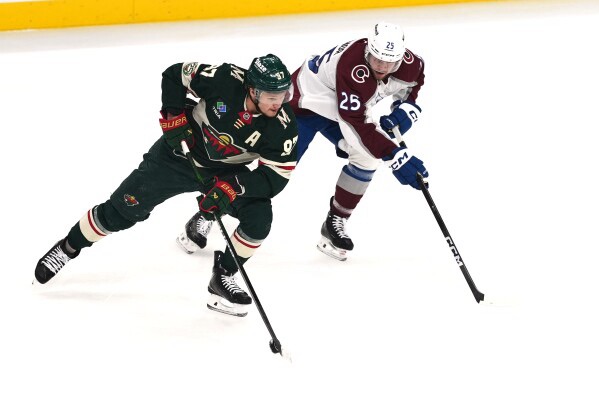
Colorado was always going to be the wall. I knew that going in. Everyone did. Nathan MacKinnon, Cale Makar, a team that had won the Presidents’ Trophy and looked, infuriatingly, like a team actually built to prove the curse wrong.
Game 1 was a 9-6 loss in Denver. Nine goals. Against the Minnesota Wild. The kind of score that does not feel real while you are watching it and feels even less real the next morning. Game 2 was 5-2, also in Colorado. Down 2-0 heading home, the series already had the feeling of something that was not going to go the way you needed it to go.
And then Game 3 happened.
The Wild handed the Avalanche their first loss of the entire postseason, 5-1, in Saint Paul, in a building that was absolutely unhinged with it. For about forty-eight hours, everything felt possible again. That is the cruelest thing about hope. It is most alive right before it ends.
Game 4 was close, 3-2 going into the final minutes, before two empty-net goals made it 5-2 and pushed the Wild to the brink. And then Game 5, in Denver, on the road, missing Joel Eriksson Ek and Jonas Brodin, down 3-1 in the series, facing a team that had not lost a home game all postseason. The Avalanche came back from three goals down to win it in overtime. Brett Kulak scored the game-winning goal. The season was over.
I sat on my couch with the same, now warm, PBR I grabbed before OT and the hurt for a long time. Longer than I expected to need.
I asked some Wild fans how they were feeling in the hours after Game 5. What I got back was not what I expected, or maybe it was exactly what I expected knowing what I know of this fanbase.
The grief was real. Lyx, 22, did not dress it up. “I’m fucking drunk, because of course I am.” That felt right. That felt like the appropriate response to a lead evaporating in the third period of an elimination game. But underneath that, they said, was something they had not expected to find there. Something that had been in them since she leaned in and asked this team, quietly and privately and in a time where they needed something, what can you offer me when it feels like I have nothing. The answer, it turned out, was hope. Optimism. A joy they described as one they were normally unfamiliar with. “We won the first round. We didn’t get swept. We lost but, fuck, we fought. I love my losing dogs, because they licked my wounds.”
That last sentence stopped me completely.
They were not the only one who came to this season carrying something. The responses I got back were full of people who had arrived at Wild hockey when they needed something to root for, something to belong to, drawn in not by a championship or a dynasty but by something more personal. A 23-year-old named Erica who had spent years on the outskirts of the fanbase, first too young to fully understand it, then too depressed to try, and found her way back in through a year of homesickness that made even a hockey game feel like home. “Wild hockey let me pretend I wasn’t stuck in an apartment in a town I hate,” she said. “But more than that, it gave me something to care about at a time when that was hard.” She came in knowing the ship might be sinking and decided to embrace it anyway. “It feels so good to be part of something, even if that something is a perpetually sinking ship.”
Miriam, 26, described the loss in terms that had nothing to do with statistics or series results. “I feel like me and all my friends were out there on the ice letting goals in and missing shots too.” That is what full investment actually feels like. Being in it, completely, to the point where the loss settles into your body the same way it would if you were the one who had just skated off the ice. She felt defeated in a way she did not think sports could make her feel. And then, in the same breath, she said she was proud. That she would wear her green sweater. That it was Wild in 2027 until it ain’t.
Sev, 26, had come to the sport this season looking for community and had found something that surprised them. She had studied fanbases academically, she said, and had been afraid of what she might find. What they found instead was a family. “Wild fans were so different to the standard and welcomed me with such open arms that it truly was like a little family you could situate yourself into regardless of knowledge.” The moment that stood out most to her was not a goal or a save or a Quinn Hughes point. It was the first round celebration. The way the people who had been with this team since birth and the people who had just arrived all celebrated with the same passion in the same moment. “It was a gorgeous display of community in the face of adversity. I quite honestly don’t think I’ll ever experience something like that again.” She paused, then added: “Until next year when they advance, optimistically.”
Aixing, 34, grew up in Minnesota and carries the pride and exhaustion of someone who has spent a lifetime telling people where they are from and watching their faces do the thing. Pity, mostly. Mild derision, they described. The gentle condescension of someone who does not think of your home as somewhere that matters. What this season gave them, among other things, was a roomful of people from all over the world who love Minnesota the way they do. “Joining the Minnesota Wild fandom experience and seeing all the love for Minnesota from fans truly all around the world was truly worth all of the heartache.” They also said something that I have been thinking about ever since. “There’s something romantic about cheering for a losing team, especially one that’s never won a cup. We’ve been the underdogs maybe the entire time we’ve been a hockey club, and there’s something tragically poetic about being the state that’s produced more NHLers than anywhere else and yet never bringing the cup home.” They are sad, they said. But also a little relieved. Relieved the injuries stop here. Relieved they do not have to beat Colorado only to lose to someone else. Relieved, they added, that they do not have to deal with whatever White House nonsense comes from winning the Cup.
That made me laugh out loud at eleven o’clock at night after a brutal playoff loss, because. Yeah.
Ash, 27, came to the Wild toward the end of the season, casually around the new year and more seriously when the playoffs picked up after the Olympics. What drew her in, she said, was not the powerplay percentage or the defensive structure or any of the things a numbers person would normally lead with, though she is very much a numbers person and got to those too. What drew her in first was the room. The way this team genuinely seems to want to be together. “I would rather support a losing team that enjoys playing and being on that team than support a winning team of guys that are killing themselves in constant pursuit of personal achievements,” she said. “I would rather see them lose in the second round every year and keep their camaraderie than win the Cup but lose the room to get there.”
She had things to say about the bracket too, and about fairness, and about the structural disadvantage of playing Dallas in six grinding physical games and then turning around to face the Presidents’ Trophy winners on a short turnaround with key players already compromised. She is not wrong about any of it. The setup was not kind to this team and the injury situation was not incidental and Colorado being better rested is a fact.
I have been thinking about what connects all of these responses, and what connects them to my own experience of this season, and I think I finally know what this piece is actually about.
It is not about the Avalanche. It is not really about Colorado’s three-goal comeback in overtime of Game 5, as much as that is going to live in my mind for the next several months. It is not even about the eleven-year drought ending in the first round, as significant as that was.
It is about what people bring to a team when they have nothing else to bring it to. And what the team gives back.
Every single person I heard from this week came to this season carrying something. Homesickness. Depression. Isolation. The loneliness of a hard year in a place that does not feel like home. The feeling of being on the outside of something looking in and not knowing how to get inside. They came to this team, some of them for the first time, some of them returning after years away, and they asked it a version of the same quiet question: what can you give me right now. And the Wild, this version of this team in this season, gave them something real. Community. Hope. The joy of caring about something alongside strangers who become, over the course of a season, something closer than that.
That is, I would argue, the whole point.
Sport does not exist to give us championships. Championships are what we say we want, and we mean it, and I want one badly. But championships are not what sport actually gives most fans most of the time. What it gives most fans most of the time is this. The season. The community. The beauty of caring about something together, of suffering the same overtime curses and observing the same superstitions and feeling, when it ends, like you were all out there on the ice together.
This Wild team gave a 22-year-old a reason to feel hope when hope was unfamiliar. It gave a 26-year-old a community she was afraid to look for. It gave someone who had been too depressed to engage with the sport she grew up with a reason to come back to it. It gave a lifelong Minnesotan a room full of people who love their state the way they do. It gave a newcomer who was afraid of sports fans a family of them. It gave someone who arrived in January and stayed through May a reason to care about things like Jared Spurgeon winning a Cup after sixteen seasons, which is the kind of investment in another person’s story that only happens when a sport has really gotten into you. It gave me, for the first time in my adult life as a Wild fan, a second round appearance to grieve instead of a first round exit to shrug off.
That is not, to me, a loss. That is a team that did something real for real people, and the fact that Brett Kulak’s overtime goal exists does not undo any of it.
Grief, it turns out, is the proof of something real. You cannot grieve for something that did not matter. You cannot feel this wrecked about a hockey series unless something was built over the course of it, something that took up residence in you and made itself at home and is now very unhappy about being asked to wait until October. The fact that Game 5 in Denver hurts the way it hurts, that is the evidence. That is what this season was. A thing that mattered enough to hurt.
And I want to say something about what it means to have made it to the second round. Not to minimize the loss, not to reach for silver linings in a way that feels cheap, but to say it plainly: eleven years is a long time to wait for something. Eleven years of first round exits and rebuilds and almost and not quite and we will get them next year. Eleven years of a fanbase training itself to hold hope loosely because holding it tightly had cost too much too many times. And this team, this version of this team in this season, broke that pattern. They made us believe in May.
It gets inside you. That is what sports do.
So this wasn’t the year. Maybe it was always going to be a different year. Maybe the year is still out there somewhere, waiting for some future April that does not exist yet, in a version of this team that comes back healthier and deeper and with a full season of Quinn Hughes and a penalty kill that has figured itself out and Joel Eriksson Ek healthy. Maybe next season we find out what this team looks like when nothing is missing and nobody is compensating for anyone else and the bracket does not ask us to play six brutal games against Dallas and then turn around and face the best team in hockey on a short turnaround. Maybe that is the year. Maybe it is the one after that.
I will be here for all of them. That has never once been the part I was uncertain about.
Go Wild. In 2027 and every year after, until it finally is.


Leave a Reply